Why Shipping an SUV or Truck Isn't the Same as Shipping a Sedan
When someone calls our dispatch team asking to ship an SUV or truck, the first thing we do is get the exact year, make, and model. That's not just paperwork. It changes everything — which trailer the carrier can use, how many spots the vehicle takes up, and what your final bill looks like.
A Ford F-250 Super Duty isn't just "a truck." To a carrier, it's 6,800 pounds, 84 inches tall, and it knocks out two standard sedan spots on a 10-car open hauler. That math hits your quote directly.
This guide breaks down exactly how size and weight affect your transport experience — from pricing to pickup windows to which carriers will even take your rig.
The Slot Problem: How Carriers Actually Load Your Vehicle
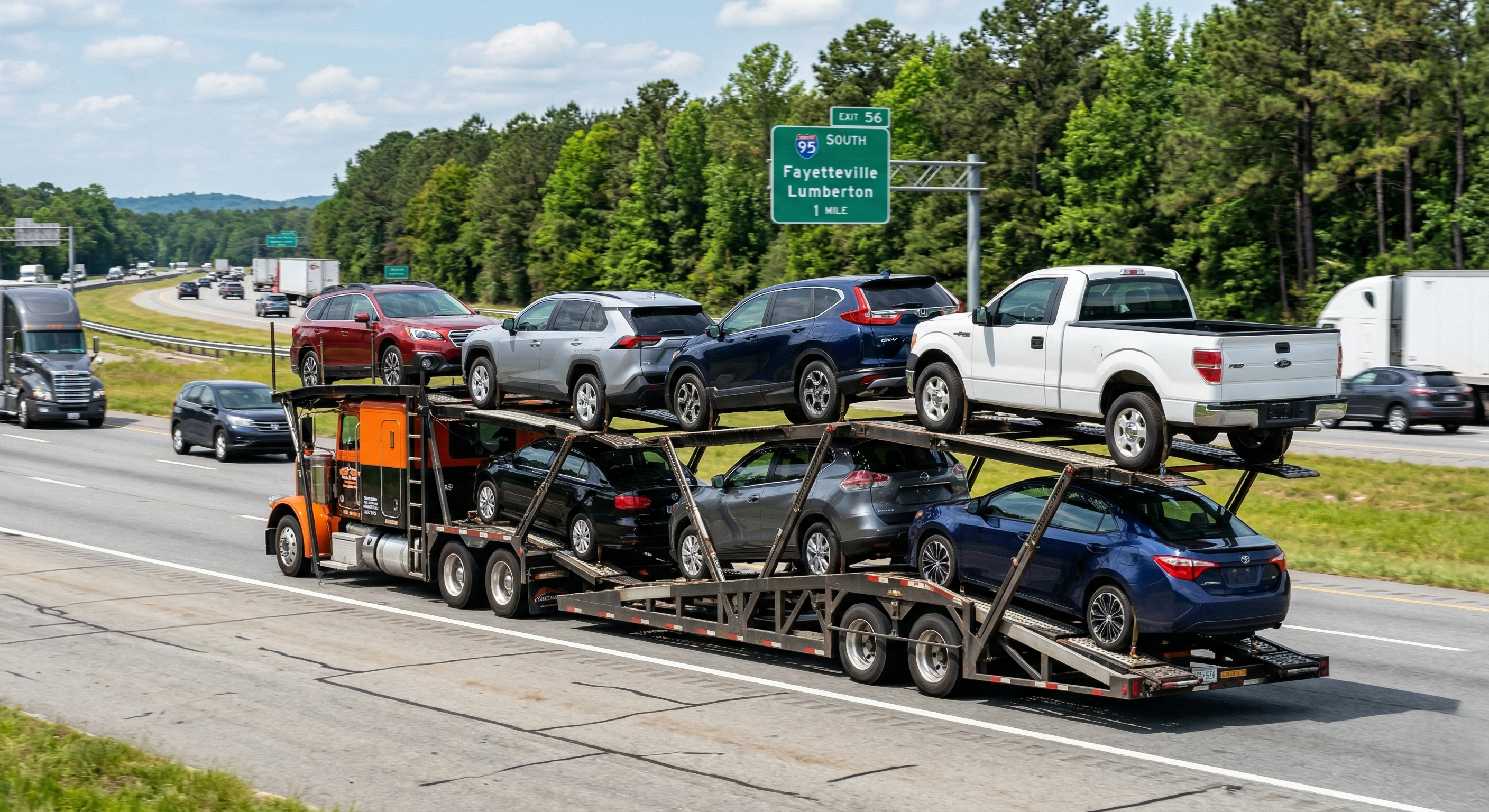
Most people don't realize that auto transport pricing is tied to physical space on the trailer, not just distance. Open carriers typically haul 8 to 10 vehicles stacked on two decks. Every slot has a height and weight ceiling.
A standard sedan fits neatly into one lower or upper slot. A full-size SUV — think Chevy Suburban or Ford Expedition — may only fit on the lower deck due to height. A dually pickup or lifted truck may require a specialized lowboy or flatbed because it simply won't clear the upper deck's clearance bar.
That's not a problem. It's just logistics. But it means fewer available carriers, a longer dispatch window, and a price that reflects the real cost of moving a big machine.
SUV vs. Truck vs. Sedan: A Real Cost Comparison by Vehicle Class
Numbers talk. Here's a realistic breakdown of what different vehicle classes cost to ship on common US corridors. These are mid-market rates on open carriers during non-peak months.
| Vehicle Class | Example Models | Avg. Height | Avg. Weight | NY to FL (Open) | CA to TX (Open) |
|---|---|---|---|---|---|
| Compact Sedan | Honda Civic, Toyota Corolla | 56–58 in | 2,800–3,200 lbs | $750–$950 | $850–$1,050 |
| Midsize SUV | RAV4, CR-V, Equinox | 63–67 in | 3,500–4,200 lbs | $850–$1,100 | $950–$1,200 |
| Full-Size SUV | Tahoe, Expedition, Suburban | 72–76 in | 5,500–6,200 lbs | $1,050–$1,350 | $1,150–$1,500 |
| Standard Pickup (2WD/4WD) | F-150, Silverado 1500, Ram 1500 | 72–76 in | 4,500–5,500 lbs | $950–$1,250 | $1,050–$1,350 |
| Heavy-Duty Pickup | F-250/F-350, Ram 2500/3500, Sierra HD | 78–82 in | 6,500–8,500 lbs | $1,200–$1,600 | $1,350–$1,800 |
| Lifted Truck / Oversized | Any truck with lift kit 4"+ or aftermarket roof | 84+ in | Varies | $1,400–$2,000+ | $1,600–$2,200+ |
These ranges assume standard open transport during regular season. Enclosed carriers, peak-season surcharges, and rural pickup locations all push rates higher.
Extended Cab, Crew Cab, Long Bed: Why Truck Configuration Changes Your Quote
Not all pickups are created equal on a transport trailer. A regular cab short bed Ram 1500 is a very different load than a crew cab long bed Ram 3500 with a gooseneck hitch and toolbox.
Here's why the configuration matters to your carrier:
- Long bed trucks (8-foot beds) often exceed the standard slot length on multi-car haulers. Carriers have to load them at an angle or skip certain slot positions, which reduces the total vehicles they can carry.
- Crew cab models add length to an already tall vehicle. A crew cab long bed F-350 dually can stretch over 22 feet bumper to bumper.
- Aftermarket accessories — including ladder racks, brush guards, camper shells, and tonneau covers — can affect both height clearance and secure tie-down points.
- Running boards and side steps add width that matters on a tightly loaded trailer deck.
Always give your broker the full picture. If you describe a truck as just a "Ram 1500," you may get a quote that changes after the carrier sees the actual vehicle. That leads to frustration at pickup. Don't let it happen.
Insider Tip: Measure your truck's height before you call for quotes — especially if it's lifted or has a camper shell. Stand a tape measure from the ground to the highest fixed point. Anything over 80 inches needs to be disclosed upfront. It saves everyone time.
Open Carrier vs. Enclosed Transport for Large Vehicles
Most SUVs and trucks ship on open carriers without any issue. Open transport is the industry standard. It's how new vehicles leave factory lots. It's affordable, widely available, and completely safe for the vast majority of vehicles.
But enclosed transport is worth considering in a few specific situations:
- You're shipping a classic or collector truck (think restored K5 Blazer or a vintage International Scout).
- Your truck has a custom wrap or specialty paint job you don't want exposed to road debris.
- You're hauling a high-end luxury SUV — Range Rover, Cadillac Escalade, or a BMW X7 — and want maximum protection.
- You're shipping during winter along northern corridors like I-90 or I-80, where road salt and slush are a real concern.
Enclosed transport for a full-size SUV or heavy-duty truck typically runs 40–60% more than open carrier rates. On a $1,200 open quote, expect enclosed to land between $1,680 and $1,920. Budget accordingly.
You can use Car Shipping Hub's cost calculator to run both open and enclosed estimates side by side for your specific vehicle and route.
Dispatch Windows Are Longer for Big Rigs — Here's What to Expect
Here's something the shipping industry doesn't always explain clearly. Finding a carrier for a standard sedan on a popular route like I-95 or I-10 might take 24 to 48 hours. Finding one for a lifted F-350 heading from Montana to Georgia? Plan on 3 to 7 business days.
This isn't a flaw in the system. It's supply and demand. There are fewer specialized carriers for oversized loads, and the ones that exist book up fast during peak season (October through December southbound, April through June northbound).
What you can do to speed things up:
- Book early. Give yourself at least 2 weeks of lead time for heavy-duty trucks or oversized SUVs.
- Be flexible on pickup dates. A 3-day window is better than a single hard date. Carriers plan routes, and a flexible window means they can slot you in faster.
- Consider a terminal drop-off. If you're near a terminal hub — like those in Dallas, Atlanta, Chicago, or Los Angeles — you can drop your vehicle there and a carrier picks it up on its next loaded run. This cuts dispatch time significantly.
- Avoid rural pickup if possible. Carriers run highways. A pickup address in a small town 60 miles off the Interstate adds time and sometimes a surcharge.
What "Non-Running" Means for Trucks and SUVs — and Why It Costs More
If your truck or SUV doesn't start or can't roll under its own power, transport costs jump. Most carriers charge an additional $150 to $300 for non-operational (inop) vehicles.
The reason is straightforward. Carriers load and unload vehicles by driving them on and off the trailer. When a vehicle can't move, the crew needs a winch — and that takes time and physical effort at every stop.
For very heavy trucks that are also non-running, you may need a flatbed or lowboy trailer specifically. These are specialty loads that require specialty carriers and specialty pricing.
Always disclose inop status upfront. Some carriers flat-out won't take non-running oversized vehicles. Better to know before dispatch than after.
Fuel Loads, Loose Items, and Pre-Ship Prep for Trucks and SUVs
Before your carrier arrives, there are a few prep steps that are especially important for large vehicles.
- Fuel level: Keep your tank at one-quarter full or less. A full tank of diesel in an F-250 adds over 130 pounds. That weight matters when a carrier calculates load distribution across the deck.
- Bed contents: Clear everything out of truck beds — gravel, tools, tie-downs, spare tires, dog kennels. Unsecured items become projectiles at highway speed. Carriers will refuse to load a truck with loose cargo in the bed.
- Tonneau covers and camper shells: Leave them on if they're bolted down. Remove pop-up or soft covers that could catch wind at 65 mph.
- Aftermarket racks: If you have a roof rack or ladder rack, confirm your carrier knows about it. Some racks affect clearance on the upper deck.
- Take photos: Walk around your entire vehicle before the carrier arrives. Photograph every panel, the bed, the roof, and all four wheels. This is your proof during the Bill of Lading inspection.
The Bill of Lading is the most important document in the whole process. The driver notes any pre-existing damage before loading. You sign it. At delivery, you compare. Any new damage gets documented on that same form before the carrier leaves. Never skip this step.
If you want a full walkthrough of the shipping process from quote to delivery, read how Car Shipping Hub's process works — it covers every step in plain language.
State-Specific Quirks That Affect Truck Transport
Certain states add wrinkles to large vehicle transport that most guides skip over.
California has strict emissions and weight regulations that affect carriers operating in-state. Some out-of-state carriers avoid California pickups because of CARB compliance requirements. This can limit carrier availability for shipments starting in cities like Fresno, Sacramento, or Riverside.
Texas is a high-volume truck state, which is good news — carrier availability is excellent on major corridors like I-35, I-10, and I-20. But rural West Texas and the Panhandle are different animals. Terminal meets in Dallas or San Antonio work well for anyone shipping a truck from a remote Texas location.
Montana, Wyoming, and the Dakotas see real carrier shortages in winter months. Carriers don't love running I-90 or I-94 through blizzard country with a top-heavy load. Budget for a longer dispatch window and a possible rate premium of $100–$200 if you're shipping a tall SUV or truck from these states between November and March.
For state-specific routing details, check out Texas vehicle transport routes and tips or find your specific state on our locations page.
Frequently Asked Questions About Shipping SUVs and Trucks
How much more does it cost to ship a full-size SUV compared to a sedan?
Expect to pay $150 to $350 more for a full-size SUV like a Tahoe or Expedition versus a compact sedan on the same route. The exact difference depends on vehicle height, weight, and current carrier availability in your lane.
Can a lifted truck be shipped on a standard open carrier?
It depends on the lift height. Trucks with lifts under 4 inches usually fit on standard open haulers. Anything over 6 inches typically requires a lowboy or specialized flatbed, which costs more and takes longer to dispatch. Always disclose lift height when you request a quote.
How long does it take to ship a pickup truck across the country?
Cross-country transport (2,500 to 3,000 miles) typically takes 7 to 10 transit days once a carrier is dispatched. Add 2 to 5 days for dispatch itself — longer for heavy-duty or oversized trucks on low-volume routes.
Does Car Shipping Hub handle heavy-duty trucks and dually pickups?
Yes. Car Shipping Hub and its trusted partner Furious Auto Shipping handle everything from standard half-ton pickups to dually one-tons and oversized work trucks. Just provide the exact year, make, model, and any modifications when you request a quote.
Can I leave tools or equipment in my truck bed during transport?
No. Truck beds must be completely clear of loose items before loading. Carriers are not responsible for unsecured cargo, and loose items can cause serious damage at highway speed. Built-in toolboxes that are bolted down and locked are generally acceptable — confirm with your carrier.
What's the cheapest way to ship a large SUV or truck?
Open carrier transport during non-peak months (February through April and July through September) offers the best rates. Being flexible on pickup dates and using a terminal meet point near a major Interstate hub can also lower your cost by $75 to $150.
Ready to Ship Your SUV or Truck? Here's Your Next Step
Big vehicles are our specialty. At Car Shipping Hub, we dispatch full-size SUVs, crew cab pickups, heavy-duty dualies, and everything in between — every single day. We know which carriers handle oversized loads, which routes have the best availability, and how to get your rig picked up fast without surprise fees.
Don't guess at your rate. Get an exact quote based on your actual vehicle and route in under two minutes.
Get Your Free Quote — no obligation, no pressure, just real numbers for your real vehicle.